
ADHD and Sleep: Why You Can’t Fall Asleep and What Helps
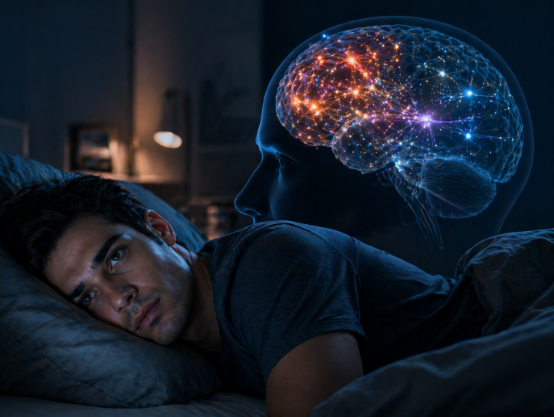
ADHD disrupts sleep because the same dopamine and norepinephrine dysregulation that drives daytime attention problems also prevents the brain from downshifting at night. This is not a willpower problem or a habit failure. It is a neurological pattern with a name, a mechanism, and evidence-based treatments that work.
If you have ADHD and you routinely lie awake for an hour or more after going to bed, feel genuinely alert at 11 PM even when you are exhausted, or cannot stop your thoughts long enough to fall asleep, you are experiencing what researchers call delayed sleep phase syndrome co-occurring with ADHD. It affects an estimated 25 to 50 percent of adults with ADHD, according to the Journal of Clinical Sleep Medicine.
Why ADHD Specifically Disrupts Sleep
 The dopamine system regulates more than attention. It also governs your internal clock, the circadian rhythm that tells your brain when to wind down. In ADHD, dopamine signaling is underactive during the day and does not reliably fall at night the way it does in neurotypical brains. The result is a brain that stays in a state of arousal well past the hour it should be quieting down.
Norepinephrine plays a related role. During the day, low norepinephrine contributes to difficulty sustaining focus. At night, it contributes to hypervigilance and an inability to let thoughts go. Both systems are implicated in ADHD. Both affect sleep.
Three specific patterns emerge consistently in adults with ADHD and sleep problems:
- Delayed sleep onset – Taking 45 minutes to two hours to fall asleep after going to bed, regardless of how tired you feel.
- Racing thoughts at bedtime – The mental quieting that normally precedes sleep does not happen. Thoughts cycle, plans form, worries surface.
- Hyperfocus at night – The ADHD tendency toward hyperfocus is worse in the evening when external demands have dropped. One more episode, one more article, one more task becomes 2 AM.
Sleep Disorders That Commonly Co-Occur with ADHD
ADHD rarely causes sleep problems in isolation. Several diagnosable sleep conditions occur at higher rates in people with ADHD than in the general population, and missing them leads to treatment that only partially works.
Delayed Sleep Phase Disorder (DSPD) is a circadian rhythm disorder in which a person’s natural sleep-wake cycle is shifted significantly later than the conventional schedule. People with DSPD are not choosing to stay up late. Their bodies are biologically timed differently. ADHD and DSPD share overlapping neurological pathways, which is why they co-occur so frequently.
Restless Legs Syndrome (RLS) affects adults with ADHD at roughly twice the rate seen in the general population. The uncomfortable urge to move the legs at rest makes sleep initiation difficult and causes frequent awakenings. Both ADHD and RLS involve dopamine pathways, which partly explains the association.
Sleep Apnea causes fragmented sleep and daytime cognitive impairment that closely mimics ADHD symptoms. Adults with untreated sleep apnea often report the same attentional difficulties, irritability, and executive function problems seen in ADHD. In some cases, treating sleep apnea substantially reduces what looked like ADHD symptoms. In others, both conditions are genuinely present, and both need treatment.
Insomnia Disorder can develop as a secondary condition when years of poor sleep create conditioned arousal around bedtime. The bed becomes associated with wakefulness and frustration rather than rest, making the ADHD-related sleep delay even harder to address.
How Poor Sleep Makes ADHD Worse
This is where the condition becomes self-reinforcing. ADHD disrupts sleep. Poor sleep worsens every ADHD symptom the next day. Worse symptoms make the evening hyperarousal worse. Worse hyperarousal delays sleep again.
According to the National Institute of Mental Health, sleep deprivation impairs prefrontal cortex function, specifically the region already underactivated in ADHD. A person with ADHD operating on five hours of sleep is not managing the same condition as someone with ADHD who slept seven. They are managing something significantly more difficult.
Clinically, this matters because patients who are sleeping poorly will appear treatment-resistant when they are actually underslept. Optimizing sleep is not a lifestyle recommendation alongside ADHD treatment. It is part of ADHD treatment.
What Actually Helps: Treatments Supported by Evidence
 For adults with ADHD and sleep problems, treatment works at the level of the underlying mechanism, not just the symptom. That means addressing the neurological and circadian components directly.
Timing ADHD Medications Correctly
Stimulant medications, including amphetamine salts (Adderall, Adderall XR) and methylphenidate (Ritalin, Concerta, Vyvanse), are first-line treatments for ADHD and can directly affect sleep depending on dose timing and formulation. A dose taken too late in the day extends dopamine and norepinephrine activity into the evening, making sleep onset even harder.
Many adults discover that adjusting when they take their medication, or switching from an extended-release to a shorter-acting formulation for the afternoon dose, meaningfully improves their ability to fall asleep. This is a medication management conversation, not a lifestyle tweak. It requires a prescribing psychiatrist who understands both conditions.
For adults whose sleep problems persist even with optimized stimulant timing, non-stimulant ADHD medications may be part of the solution. Guanfacine (Intuniv) and clonidine are alpha-2 agonists that can reduce the evening hyperarousal associated with ADHD and have evidence supporting their use in sleep-onset problems. Atomoxetine (Strattera) is another non-stimulant option that does not affect sleep as directly as stimulants.
A board-certified psychiatrist evaluating ADHD and sleep together will consider all of these options based on the full clinical picture, including which co-occurring sleep disorder, if any, is present.
Melatonin for Delayed Sleep Phase in ADHD
Melatonin is not primarily a sedative. It is a timing signal. Taken at the right time, typically two to four hours before the desired sleep onset, it shifts the circadian clock earlier. For adults with ADHD and DSPD, low-dose melatonin (0.5 to 1 mg) used consistently has good evidence for advancing sleep timing without the tolerance and dependence concerns associated with sedative medications.
Over-the-counter melatonin products in the United States are typically dosed far higher than what the research supports for circadian shifting. A psychiatrist can guide the correct dose and timing for this specific use.
Cognitive Behavioral Therapy for Insomnia (CBT-I)
CBT-I is the first-line treatment for insomnia disorder according to the American Academy of Sleep Medicine. It addresses the conditioned arousal and unhelpful thought patterns around sleep that develop after years of poor sleep. For adults with ADHD who have developed secondary insomnia, CBT-I treats the learned component of their sleep problem while medication management addresses the neurological component.
The combination of optimized ADHD medication timing, appropriately used melatonin for circadian shifting, and CBT-I for any secondary insomnia is currently the most evidence-supported approach for adults presenting with both ADHD and sleep difficulties.
Sleep Hygiene: What Helps and What Gets Overstated
Standard sleep hygiene recommendations, consistent bedtimes, dark rooms, and no screens are genuinely useful but insufficient as a standalone intervention for adults with ADHD. The reason is that the problem is neurobiological, not primarily behavioral. Telling someone with ADHD and DSPD to simply go to bed earlier addresses none of the underlying circadian or dopaminergic mechanisms.
That said, a few behavioral changes have specific relevance for ADHD sleep problems. Bright light exposure in the morning, ideally within 30 minutes of waking, helps anchor the circadian clock earlier. Evening exercise, particularly intense exercise within two to three hours of bedtime, can extend the hyperarousal window and delay sleep. And the ADHD-specific pattern of hyperfocusing into the night requires environmental structure that reduces access to stimulating activities after a certain hour, not because of screen light, but because of the engagement risk.
If you are managing ADHD symptoms and sleep problems together, a psychiatric evaluation can clarify which components are neurological, which are circadian, and which are behavioral, and build a treatment plan that addresses all three.
When to See a Psychiatrist Instead of Just Trying Harder
 The following patterns warrant a psychiatric evaluation rather than another round of sleep hygiene adjustments:
- You have a confirmed ADHD diagnosis, and your sleep has not improved with your current medication regimen.
- Sleep problems began or worsened after starting a stimulant medication.
- You regularly cannot fall asleep until 1 AM or later, regardless of when you try to sleep.
- Daytime fatigue is impairing your functioning to the degree that ADHD symptoms did before treatment.
- You are using alcohol, cannabis, or over-the-counter sleep aids regularly to fall asleep.
- A bed partner reports that you stop breathing, snore heavily, or have significant leg movements during sleep.
Each of these patterns points toward a specific, treatable clinical issue. None of them resolves with more willpower or a stricter bedtime routine.
Adults with suspected or diagnosed ADHD who have sleep complaints should be evaluated for the full range of co-occurring sleep disorders before concluding medication adequacy. Many apparent treatment failures in ADHD are actually undertreated sleep disorders.
Patients managing both conditions benefit most from a prescribing psychiatrist who can evaluate both the sleep disorder and the ADHD together, rather than treating them as separate problems handled by separate providers.
Frequently Asked Questions
Does ADHD cause insomnia?
ADHD does not directly cause insomnia as a primary diagnosis, but it reliably disrupts sleep onset and sleep quality through neurological mechanisms involving dopamine and circadian rhythm dysregulation. Secondary insomnia, meaning insomnia that develops as a result of years of conditioned arousal around bedtime, is common in adults with longstanding ADHD and sleep difficulties. The two conditions require somewhat different treatment approaches, which is why accurate diagnosis matters.
Will treating my ADHD fix my sleep problems?
Often partially, but rarely completely, on its own. Stimulant medications improve daytime ADHD symptoms and can indirectly improve sleep by reducing the hyperarousal associated with untreated ADHD, but they can also worsen sleep onset if dosed incorrectly. Most adults with ADHD and significant sleep problems need a treatment plan that addresses both conditions, including medication timing optimization, possible circadian interventions like melatonin, and, in some cases, CBT-I for secondary insomnia.
Can sleep deprivation mimic ADHD symptoms?
Yes, and this creates a real diagnostic challenge. Chronic sleep deprivation impairs prefrontal cortex function and produces inattention, impulsivity, irritability, and working memory deficits that look clinically similar to ADHD. A thorough psychiatric evaluation for ADHD should include assessment of sleep quality and duration, and in some cases, treatment of an underlying sleep disorder should precede or accompany ADHD treatment to avoid misattributing sleep-deprivation symptoms to ADHD.
Is it safe to take melatonin with ADHD medication?
Low-dose melatonin used for circadian shifting is generally compatible with stimulant ADHD medications and is one of the better-studied interventions for ADHD-related sleep onset delay. However, the timing, dose, and formulation matter significantly, and the interaction profile should be reviewed by your prescribing psychiatrist rather than managed independently. Over-the-counter melatonin products are often dosed five to ten times higher than what research supports for sleep timing purposes.
Should I get a sleep study if I have ADHD?
A sleep study (polysomnography) is indicated if there is clinical suspicion for sleep apnea or significant restless legs syndrome alongside ADHD. Both conditions occur at elevated rates in adults with ADHD and can substantially worsen cognitive function. If a bed partner reports apnea episodes or heavy snoring, or if you experience intrusive urge-to-move sensations in your legs at rest, a sleep study referral is appropriate. Your psychiatrist can help determine whether a sleep medicine referral is indicated based on your symptom picture.
PsychBright Health: ADHD and Sleep Evaluated Together
PsychBright Health is a psychiatry practice in Los Angeles founded and led by Dr. Daniel Duel, MD, a board-certified psychiatrist specializing in general adult psychiatry and addiction medicine. The practice accepts Aetna, Blue Shield, UHC, Cigna, Anthem, Medicare, and Medicare Advantage, and same-week evaluations are available within five business days.
If you are dealing with ADHD and sleep problems that are not fully resolved by your current treatment, a thorough psychiatric evaluation can identify what is driving both issues and what needs to change. Call (213) 584-2331 or request an appointment online to schedule.
PsychBright Health
1180 S Beverly Dr #700
Los Angeles, CA 90035
Phone: (213) 584-2331
Monday through Friday, 8 AM to 5 PM